
The Essential Guide to Urban and Travel Sketching Supplies
Updated: Aug 7
The Biggest Mistake I Made as a Beginner
I thought:
I needed a bigger palette
I needed professional paints
The perfect sketchbook
Expensive brushes
Fancy accessories
The “right” setup
And because of that mindset, I delayed creating art. I researched more than I practised. If I could go back and give myself one piece of advice, it would be this: Start sketching with whatever you already have. Your skills grow through mileage, not shopping.
Of course, good materials can make the process more enjoyable later on — but they are not what makes someone an artist.
Choosing the Right Sketchbook
Sketchbooks are very personal, and honestly, there is no perfect one. For urban sketching, I usually look for:
Good paper for watercolour, 200gsm to 300gsm
Something easy to carry daily
For travel sketching, depending on how long the trip is, I might:
Take a larger sketchbook to accommodate more sketches in one spread
Be mindful of how much weight and bulk I want to carry while travelling.
But for both situations, I prefer sketchbooks that feel approachable rather than precious. If a sketchbook feels too expensive or “too beautiful,” I sometimes become afraid of ruining it. That perfectionism can stop creativity very quickly.
My Advice for Beginners
Start with:
Medium or small size
Paper that can handle a little water, around 150gsm can handle light washes
You do not need 100% cotton paper immediately. In fact, my current sketchbooks don't have 100% cotton paper. I bind my own sketchbooks using Bockingford NOT 300gsm watercolour paper. But in my early years, I made my sketchbooks using cheap hot-press watercolour paper from a dollar store in Canada, and they served the purpose at the time quite well, which was to learn, practice, and make mistakes without worrying about it. I still buy simple sketchbooks with 150gsm paper that I use daily for messy sketches to practice and improve.
The important thing is filling pages — not owning luxury paper.
✏️ Pens, Pencils & Fineliners
I like keeping my drawing tools extremely simple. Usually, I carry:
Three fineliners and a brush tip marker
That’s it. You do not need an entire pencil case full of options.
Pencils
A regular or mechanical pencil with HB or 2B lead is enough for planning sketches and lightly mapping shapes. I try not to overcomplicate the drawing stage.
Waterproof Fineliners
Fineliners are wonderful for urban sketching because they:
Don't bleed through paper
Are lightfast
Are waterproof and fadeproof
Create precise lines
Are archival quality and pH neutral
You do not need multiple nib sizes in the beginning. But I have with me on my urban and travel sketching sizes 0.1, 0.3, 0.8, and a brush nib. But for beginners, one pen is enough to create hundreds of sketches. Brands that I usually buy are SAKURA Pigma Micron and UniPin, but any brand would be fine as long as you buy them waterproof. That is very important when using watercolour on top, so your sketch doesn't smudge.
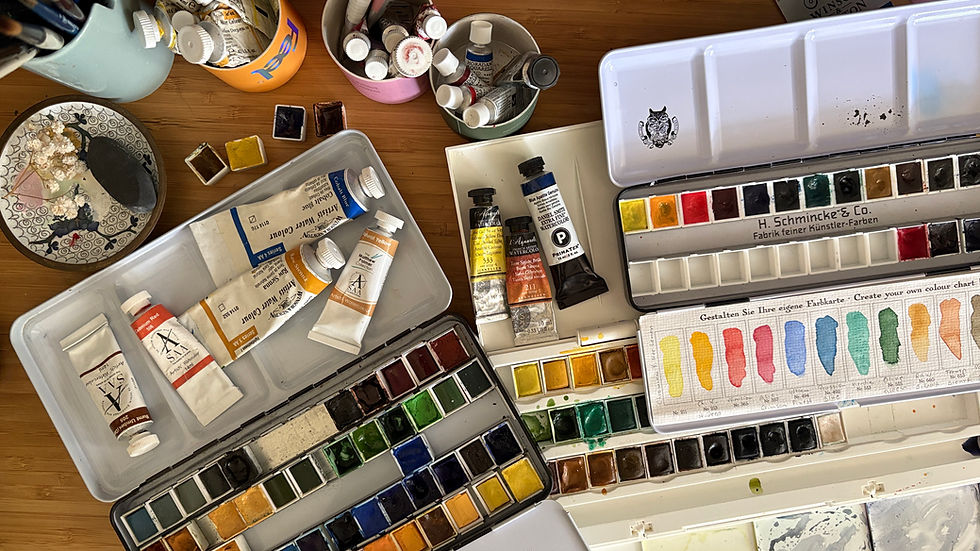
🎨 Watercolour Sets: Student Grade vs Artist Grade
This is one of the most common questions beginners ask. And the truth is: Both can work.
On my first online watercolour class that I took, I used a kids' watercolour set (which I don't recommend). Soon after, I was gifted with a Winsor & Newton Cotman Sketchers Pocket set (student-grade), and for years, I used this small travel set, and it was absolutely enough to learn:
Colour mixing
Brush control
Confidence
Observation
You don't need artist-grade watercolour to start. I think upgrading slowly makes much more sense than feeling pressured to buy everything immediately. A small set with a limited palette can teach you far more than a giant collection of colours.
Brushes: Keep It Simple
Brushes were another area where I thought I needed sable natural brushes for better results, which is not necessarily true. When I started, I bought a very affordable set of watercolour brushes from Winsor & Newton. They were not the best quality, but still good enough to start. I spent a lot of time online searching for brushes to buy, but I only upgraded to professional brushes many years later.
I was lucky to get my hands on a bundle of second-hand art supplies on Facebook Marketplace, where I acquired a huge lot of professional brushes, mostly sable brushes. But now? I mostly use just a couple of brushes.
For travel and urban sketching, I recommend travel brushes because they are compact, easy to carry, and the lid protects the shape of the brush.
That’s genuinely enough. A good round brush can:
Paint washes
Create details
Hold water well
Adapt to many styles
You do not need 20 brushes. In fact, too many options can become distracting.
The Small Essentials I Always Carry
These tiny items make sketching easier without adding much weight.
Essentials
Small water container (collapsible cup)
Paper towel or cloth
The spray bottle is especially useful for reactivating dried paints while sketching outdoors.
Optional Extras
These are not necessary, but they can be fun additions later.
Wonderful for highlights and corrections, but I also use it to mix with my watercolours to change the opacity of the paints.
Great for tiny details and light accents.
Helpful for windy days when sketchbook pages won’t stay open.
Protecting parts of the page or to create a border while painting.
But remember: These are extras — not requirements. Do not let optional supplies stop you from sketching.
My Compact Sketching Bag
One of the best things I ever did was reduce the amount I carried. Now everything fits into one compact bag that is:
Lightweight
Easy to access
Comfortable to travel with
This changed my sketching habits completely. Because my kit is simple:
I sketch more often
I feel less overwhelmed
Setup is faster
Packing is easier
I focus on the experience instead of the equipment
And honestly, that’s what urban sketching is really about. Not perfect supplies. Not perfect pages. Just observing the world and telling visual stories.
💭 Final Thoughts
If you are waiting until you can afford the “perfect” art supplies before starting urban sketching, I want to encourage you to stop waiting. Use what you have. A cheap sketchbook and a simple pen can still capture beautiful moments. Your style, confidence, and artistic voice develop through practice — not through owning more things.
Some of my favourite sketches were made with the simplest materials. And I truly believe simplicity creates freedom. So pack light, lower the pressure, and go sketch something today. Even imperfect pages are helping you grow.
🎁 Want a Little Help Getting Started?
If you’re not sure what to draw, I’ve created a free The Ultimate eBook, The Complete Beginners Guide to Urban & Travel Sketching with simple prompts and ideas to help you fill your first pages.
And if you’d like more guidance, inside my course Sketch Your Travels, that will be launching soon, I walk you step by step through building a sketchbook practice with ink, watercolour, and storytelling—without pressure or perfection. Join the waitlist for my upcoming course and learn how to sketch your travels with confidence, simplicity, and joy.
When you join the waitlist, you’ll receive the eBook.


Comments